The Antenna That Picks Up Nothing Useful
I built a software-defined radio setup to monitor the 1420 MHz hydrogen line. The hydrogen line is the frequency at which neutral hydrogen emits radiation — it's the frequency SETI researchers have historically focused on because it's universal and quiet. I wasn't expecting to find anything. I was mostly doing it because the hardware is cheap and the software is interesting.
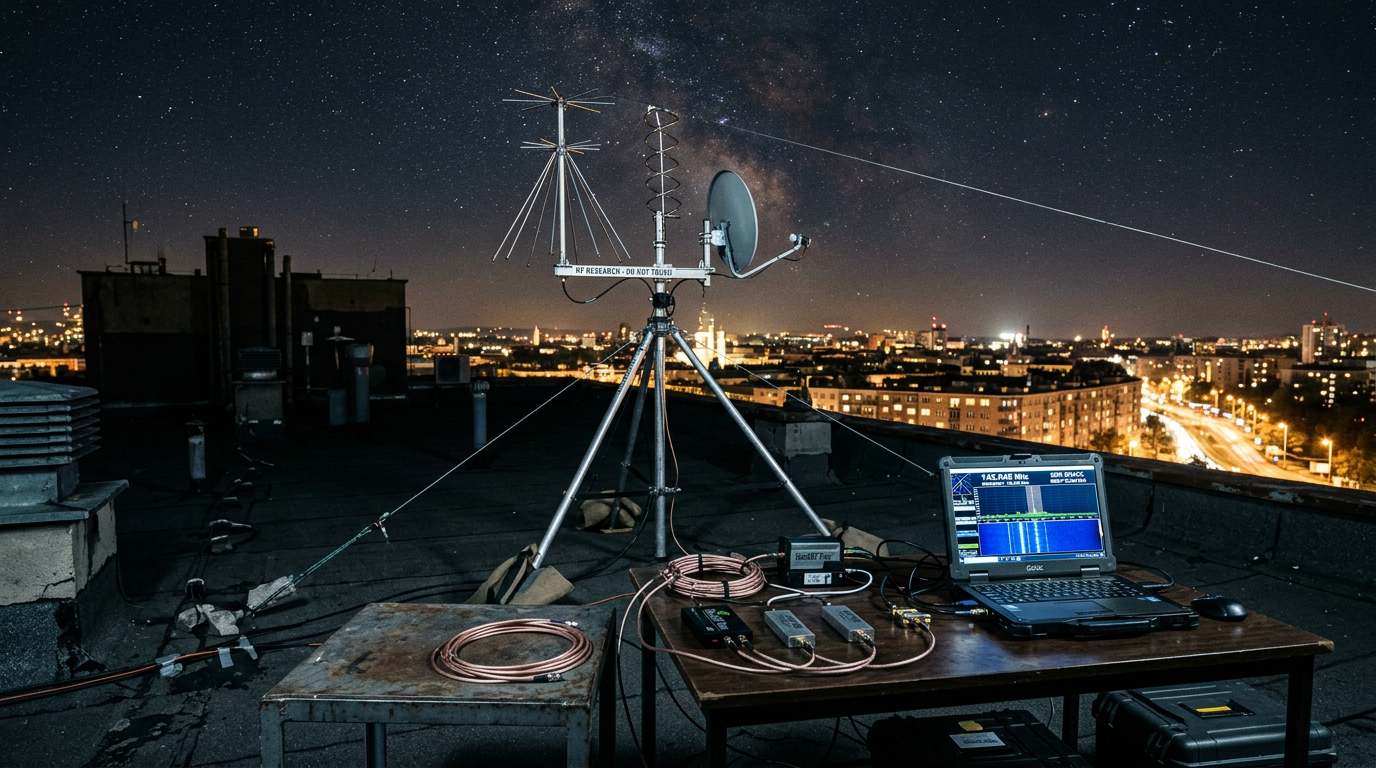
What I found instead was a repeating pattern at a slightly different frequency that I can't explain and probably shouldn't have found. I say "probably shouldn't have found" because the pattern is consistent enough that if it were a known phenomenon, it would be documented. It isn't documented. Or if it is, I haven't found the documentation.
The Setup
RTL-SDR dongle, a homemade yagi antenna, GNU Radio for signal processing. Total hardware cost under $50. The software is free. This is the thing about SDR — the barrier to entry is almost nothing, which means a lot of people are pointing antennas at the sky and recording what they find.
The technical setup details are worth documenting separately — the antenna design, the gain settings, the filtering. The short version: nothing exotic. Standard hobbyist equipment pointed at a standard frequency.
The Pattern
It repeats every 73 minutes. Not exactly 73 minutes — there's a drift of about 4 seconds per cycle, which is consistent with a source that's moving relative to my position. The signal is narrow-band, which rules out most terrestrial interference. It's not a satellite — I've checked the orbital databases. It's not a known beacon.
The cryptic signals archive has been documenting similar anomalies — patterns that don't fit the known catalog. I'm not claiming anything. I'm documenting what I found and inviting other people with SDR setups to look for the same pattern.
What It Probably Is
Probably something mundane. A piece of hardware I haven't identified. A reflection off a structure that creates a consistent delay. A software artifact in my processing chain. I've tried to rule these out and haven't been able to, which is either interesting or a sign that I'm missing something obvious.
The pattern recognition work is relevant here — the question of when a pattern is signal and when it's noise, and how you tell the difference when you don't know what you're looking for.
More anomalies and fringe tech at Spaxob.