Why the period matters
A single burst carries as much energy in a few milliseconds as the Sun releases in several days, yet the source sits roughly half a billion light-years away. The repeating window implies some orbital or rotational clock rather than random flares. One workable picture places a magnetar in a tight binary with a companion star whose wind periodically obscures or triggers the emission. Other ideas invoke precession of a neutron-star jet or even an accretion disk that waxes and wanes, though none of these models yet accounts for every observed property.
Observing the window
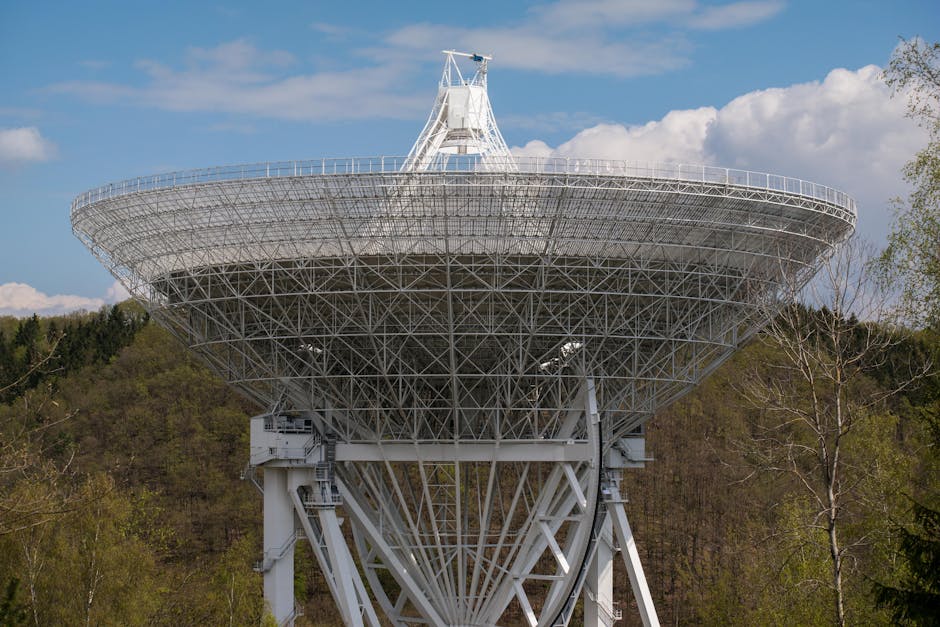
CHIME catches activity inside a roughly five-day active phase centered on the predicted peak. Outside that interval the source stays quiet down to the telescope’s sensitivity limit. Follow-up campaigns with the Very Large Array and the European VLBI Network have pinned the location to a star-forming region in a spiral galaxy, narrowing the field of possible progenitors but not eliminating any of them. The repeating fast radio bursts therefore supply a rare laboratory for testing how compact objects interact with their surroundings over long timescales.
Uncertainty lingers on whether the 16.35-day cycle will hold indefinitely. A handful of cycles have now been tracked, and the phase remains stable, yet small deviations could appear if the orbit is eccentric or if the emission mechanism itself drifts. Radio astronomers continue to monitor the source through multiple orbits precisely because a single mismatch could rule out entire classes of models.
“The periodicity is the cleanest clue we have, but it still leaves room for several physical pictures.”
Comparisons with other sources
FRB 20180916B is not the only repeater. FRB 121102 shows bursts clustered in time but without a detected period. The contrast suggests that periodic and aperiodic repeaters may represent different evolutionary stages or different companion configurations. Optical and X-ray observations of the host galaxy of 20180916B reveal ongoing star formation yet no obvious high-mass X-ray binary at the precise burst location, leaving the companion hypothesis intact but unconfirmed.
One concrete check involves the dispersion measure, which stays constant across cycles to within measurement error. That stability argues against an expanding supernova remnant or a varying plasma screen along the line of sight. The patterns in cosmic transients therefore appear intrinsic to the source rather than propagation effects.
Future checks
Longer baselines will test whether the period itself changes slowly, as expected in an inspiraling binary. If the cycle lengthens or shortens at a measurable rate, orbital decay could be inferred directly. Current upper limits already exclude certain high-mass companions at very short periods, but wider orbits remain compatible with the data. The same monitoring also supplies a rolling prediction for when the next active window opens, allowing efficient scheduling of sensitive instruments.
Whether the underlying engine is a magnetar, a black-hole accretion flow, or something else entirely, the 16.35-day clock offers a fixed reference against which other observables can be measured. Each new cycle simply adds another data point to a growing time series that, so far, shows no sign of winding down.

Additional context comes from polarization measurements. The bursts exhibit high linear polarization that rotates across the active window in a manner consistent with a changing viewing angle. That geometric signature fits neatly with a precessing or orbiting emitter, though the exact angle remains underconstrained. The repeating signals in radio astronomy thus continue to reward patient accumulation of events rather than single dramatic detections.
Ground-based arrays now under construction will improve both sensitivity and localization, potentially revealing whether faint, persistent radio emission accompanies the bursts. If such a counterpart exists and varies with the same period, it would strengthen the binary-companion scenario. Until then, the source remains an outlier whose regularity is real but whose engine stays just out of reach.
the 16-day cycle of FRBs has already shifted how observers allocate time on large telescopes, turning what began as serendipitous finds into a scheduled campaign.